


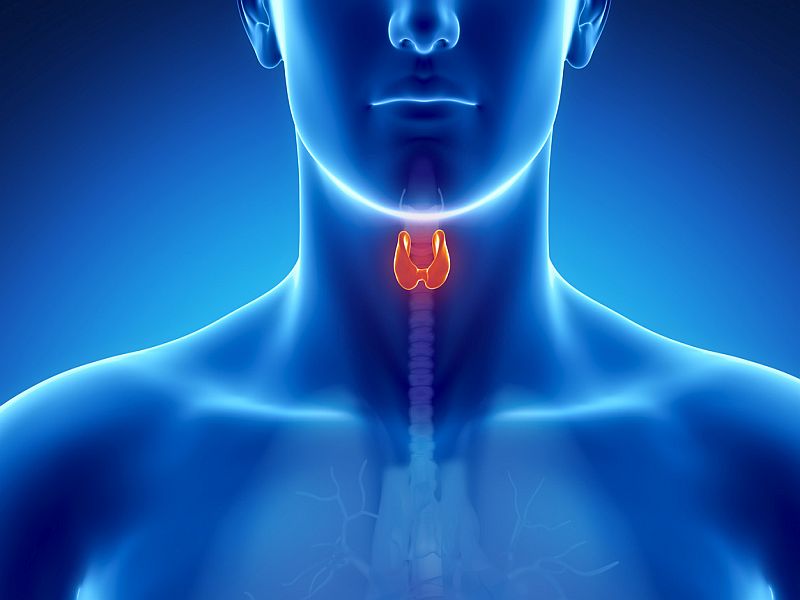
 No increased risk for recurrence with 1.1 GBq versus 3.7 GBq RAI at 3-, 5-, 7-year follow-up
TUESDAY, Nov. 6, 2018 (HealthDay News) — For patients with low-risk thyroid cancer, low-dose radiation is not associated with an increased risk for recurrence versus high-dose radiation over almost seven years of follow-up, according to a study presented at the 2018 National Cancer Research Institute Cancer Conference, held from Nov. 4 to 6 in Glasgow, Scotland.
Jon Wadsley, M.B. B.Chir., from University College London, and colleagues randomly assigned 434 patients with differentiated thyroid cancer to receive either low administered radioactive iodine (RAI) activity of 1.1 GBq or standard high RAI of 3.7 GBq following surgery, each with either Thyrogen or thyroid hormone withdrawal (THW).
The researchers found 21 recurrences during nearly seven years of follow-up (11 with 1.1 GBq RAI and 10 with 3.7 GBq RAI). The three-, five-, and seven-year recurrence rates did not differ significantly between the 1.1 GBq and 3.7 GBq groups (1.5, 2.1, and 5.9 percent, respectively, versus 2.1, 2.7, and 7.3 percent, respectively; hazard ratio, 1.10; 95 percent confidence interval, 0.47 to 2.59; P = 0.83). Within T- and N-stage groups, 1.1 GBq was not associated with significantly more recurrences than 3.7 GBq. The three-, five-, and seven-year recurrence rates did not differ significantly for patients using Thyrogen and those using THW (hazard ratio, 1.62; 95 percent confidence interval, 0.67 to 3.91; P = 0.28).
“Not only is lower activity preferable for patients, it can also result in cost savings to the health service,” Wadsley said in a statement.
 Obesity Linked to Early-Onset Cancer Risk in Young Adults
 Early Survivorship Care Linked to Improved Outcomes in Head, Neck Cancer
 ASTRO Issues Guidance for Use of Radiation Therapy in Bladder Cancer
 Recommendations Updated for Radiation Therapy in Pancreatic Cancer
.jpg) Composite Biomarker Helps ID Early-Stage Pancreatic Ductal Adenocarcinoma
 Thymic Radiation Linked to Worse Outcomes in Patients With NSCLC
 Aircrew Face Higher Odds of Radiation-Related Cancer Deaths
 65.8 Percent of U.S. Counties Lack Radiation Oncology Practice Site





