


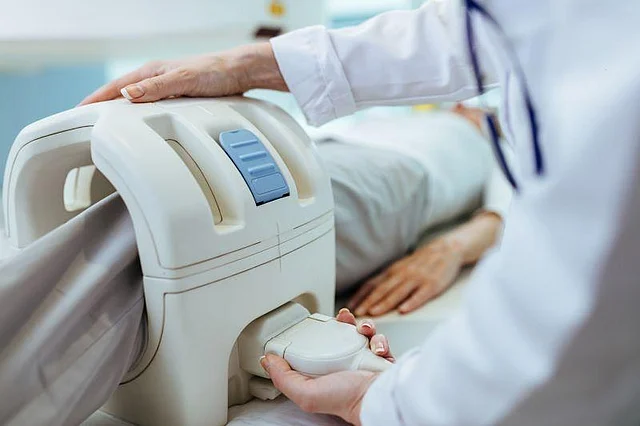
Deep learning reconstructed knee MRI imaging diagnostically equivalent to conventional accelerated MRI for detecting abnormalities
THURSDAY, Jan. 26, 2023 (HealthDay News) — Deep learning (DL) reconstructed knee magnetic resonance imaging (MRI) is diagnostically equivalent to conventional accelerated MRI for evaluating internal derangement of the knee in a clinical setting, according to a study published online Jan. 17 in Radiology.
Patricia M. Johnson, Ph.D., from the New York University Grossman School of Medicine in New York City, and colleagues examined the diagnostic equivalence of prospectively accelerated DL-reconstructed knee MRI versus conventional accelerated MRI for assessing internal derangement of the knee in a clinical setting. A DL model was trained using images from 298 clinical 3-T knee examinations. Between January 2020 and February 2021, patients clinically referred for knee MRI underwent a conventional accelerated knee MRI protocol at 3 T followed by an accelerated DL protocol. The equivalence of DL reconstruction of the images was assessed relative to the conventional images for detection of an abnormality. Six musculoskeletal radiologists reviewed each examination.
Overall, 170 participants were assessed. The researchers found that for detection of abnormalities, the DL-reconstructed images had diagnostic equivalence to conventional images. For the DL versus conventional images, the overall image quality score, averaged over six readers, was significantly better.
“This work demonstrates that DL reconstruction of accelerated knee MRI at 3 T does work reliably in a real clinical setting with real patients,” the authors write. “Important future steps include correlating reader assessments of pathologic findings with a surgical ground truth and establishing robustness across a variety of scanners and vendors.”
Several authors disclosed financial ties to medical technology and technology industries.
Abstract/Full Text (subscription or payment may be required)
 Early Postpartum Brain Loss Prominent but Reversible in MS
 Low Diagnostic Yield Seen for Postmastectomy Imaging in Patients With DCIS
 Greater Estrogen Exposure Linked to Lower Cerebrovascular Pathology
 AI Better Assesses Heart Function From MRI Than Clinicians
 Pre-Prostate Biopsy MRI Use Increased From 2017 to 2026
 PET/MRI Offers Diagnostic, Prognostic Value in Pediatric Epilepsy
 Nighttime Light Exposure Linked to Adverse Cardiac Remodeling
 Brain Abnormalities Identified in Children at Risk for Schizophrenia





.jpeg)