


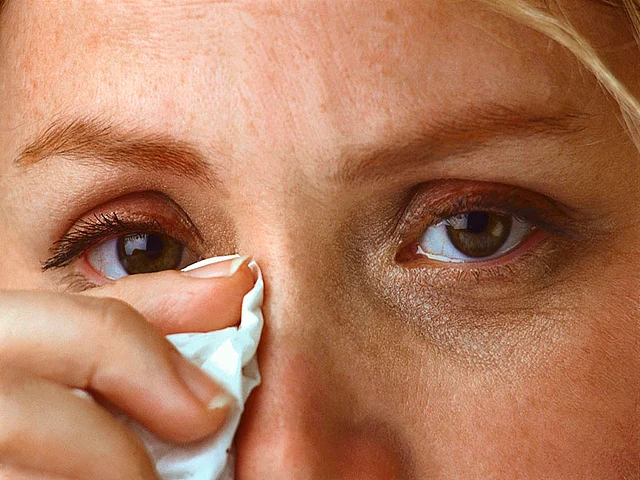
Among hospitalized patients with SARS-CoV-2, eyes with CS positivity had significantly higher conjunctival redness grade
MONDAY, April 18, 2022 (HealthDay News) — For hospitalized patients with severe acute respiratory syndrome coronavirus 2 (SARS-CoV-2) positivity, conjunctival swab (CS) positivity is 12.7 percent, and 45.1 percent have at least one conjunctival manifestation, according to a research letter published online April 19 in JAMA Network Open.
Emilio Pedrotti, M.D., from the University of Verona in Italy, and colleagues examined the prevalence of SARS-CoV-2-related conjunctival manifestations and CS positivity on hospital admission (T1) and three days thereafter (T2) among a sample of 142 patients not receiving anti-inflammatory treatment. All patients received hyaluronic acid artificial tears (ATs) twice daily in the clinically worse eye: nonpreservative-free (NPF) ATs with povidone iodine were administered at one hospital and preservative-free (PF) ATs were administered at two hospitals. Conjunctival redness (CR) and other conjunctival signs and symptoms (OCSSs) were compared between T1 and T2 and between AT-treated and nontreated eyes.
The researchers found that 12.7 percent of the patients had a positive CS result and 45.1 percent had at least one clinical finding (e.g., CR). Eyes with CS positivity had significantly higher CR grade. At T2, 8.5 percent of patients had a positive CS result. Five additional patients were in the non-AT group and 14 fewer in the AT group. Among nontreated eyes, redness worsened, while among AT-treated eyes, both CR and OCSSs improved. NPF-ATs were 1.13 times more effective than PF-ATs for improving CR and were the only formulation able to reduce OCSSs and CS positivity.
“These results suggest a concordance between CR grade and CS positivity,” the authors write.
 Ambient Temperature Linked to Intraocular Pressure in Glaucoma
  Virtual Reality-Based Digital Defocus Vision Training May Aid Myopia in Children
  Highly Aspherical Lenslets Effective for Reducing Myopia Progression in Children
  Dexamethasone Eye Drops Can Reduce Progression to ROP Requiring Treatment
  Very Preterm Birth, Very Low Birth Weight Linked to Lower Positive Functioning in Early Adulthood
  Plasmapheresis Linked to Improved Outcomes for MOGAD Attacks
  Novel Treatment Regimen Promising for Diabetic Macular Edema
  Racial, Ethnic Differences Seen in Inhaler Use for Asthma in U.S. Adults
 .jpg)




