


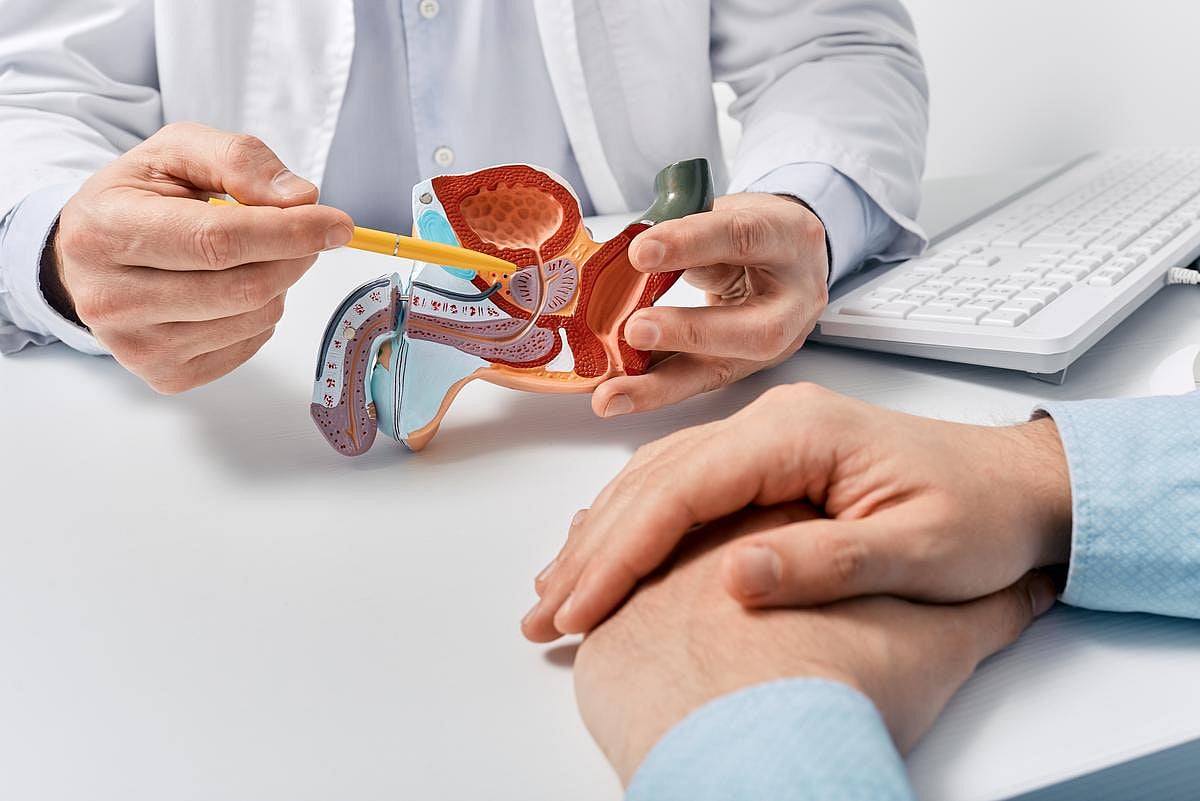
Shorter hospitalization and lower transfusion rates seen with pulsed Thulium:YAG laser enucleation versus open simple prostatectomy
TUESDAY, June 30, 2026 (HealthDay News) — For patients with benign prostatic hyperplasia (BPH), early functional outcomes are comparable with high-peak-power pulsed Thulium:YAG laser enucleation (p-ThuLEP) and open simple prostatectomy (OSP), but shorter hospitalization and lower transfusion rates are seen with p-ThuLEP, according to a study published online May 30 in Translational Andrology and Urology.
Alberto Zambudio-Munuera, M.D., from San Cecilio University Hospital in Granada, Spain, and colleagues compared early perioperative, functional, and bleeding-related outcomes between p-ThuLEP and OSP in patients with large-gland BPH in a retrospective comparative observational study including 98 consecutive patients with prostate volumes of 80 to 150 mL treated between January 2023 and May 2025. To obtain comparable group sizes, cases were selected in a 1:1 ratio.
The researchers found that hospital stay and catheterization time were significantly reduced with p-ThuLEP (mean difference, −3.04 days and −6.42 days, respectively), as were transfusion rates (0 versus 12.2 percent). Comparable early improvements were seen in both groups in International Prostate Symptom Score and maximum flow rate. Anticoagulant use independently predicted hematuria in multivariable analysis (odds ratio, 9.39), while a strong, but non-significant association was seen with the surgical approach. There was no independent association for prostate volume with bleeding events.
“Within these limits, p-ThuLEP appears to be a safe minimally invasive alternative for large prostates when performed in experienced centers. Prospective studies with longer follow-up and formal comparative designs are required to confirm long-term durability and more precisely define its role among surgical options,” the authors write.
 Implant, Patient Survival Do Not Differ for Robotic and Conventional Total Joint Replacement
  Physical Therapist-Supervised Exercise Improves Outcomes After ACL Reconstruction
  Early Complications Common in Older Kidney Transplant Recipients
  PET/MRI Offers Diagnostic, Prognostic Value in Pediatric Epilepsy
  Drug Interactions Reducing Contraceptive Effectiveness Common in Epilepsy
  Pre-Prostate Biopsy MRI Use Increased From 2017 to 2026
  Frequent Cannabis Use Linked to Epilepsy Severity
  Less Intraoperative Crystalloid Fluid Not Tied to Worse Surgical Outcomes


.jpg)
