


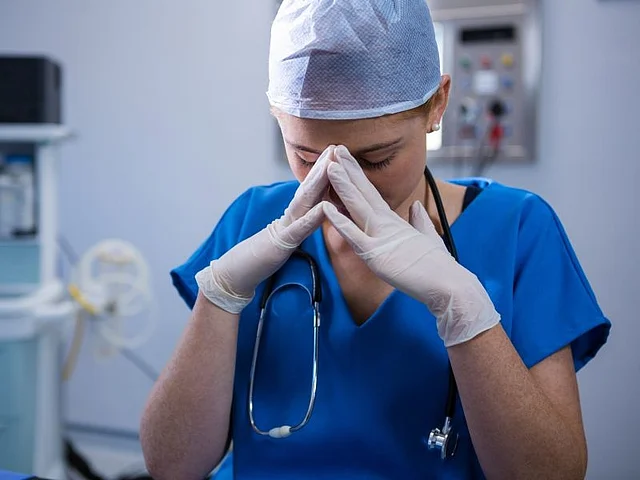
Patient-facing health care workers and their households have significantly increased risk for admission
FRIDAY, Oct. 30, 2020 (HealthDay News) — Health care workers and their households account for 17.2 percent of COVID-19 admissions in the working-age population, according to a study published online Oct. 28 in The BMJ.
Anoop S.V. Shah, M.D., from the London School of Hygiene and Tropical Medicine, and colleagues examined the risk for hospital admission for COVID-19 among health care workers aged 18 to 65 years, their households, and other members of the general population in Scotland from March 1 to June 6, 2020. The cohort included 158,445 health care workers (57.3 percent patient-facing) and 229,905 household members.
The researchers found that 17.2 percent of all hospital admissions for COVID-19 in the working-age population (18- to 65-year-olds) were in health care workers or their households. The risk for admission due to COVID-19 was similar in non-patient-facing health care workers and their households and in the general population (hazard ratio, 0.81 [95 percent confidence interval, 0.52 to 1.26] and 0.86 [95 percent confidence interval, 0.49 to 1.51], respectively) after adjustment for confounding variables. However, patient-facing health care workers and their family members had an increased risk compared with non-patient-facing health care workers (hazard ratios, 3.30 [95 percent confidence interval, 2.13 to 5.13] and 1.79 [95 percent confidence interval, 1.10 to 2.91]).
“High quality prospective studies evaluating new prevention and control practices will be important to guide improvements in our approach to protecting health care workers and their families,” write the authors of an accompanying editorial.
 2013 to 2024 Saw Decrease in Benzodiazepine Prescribing
  Less Intraoperative Crystalloid Fluid Not Tied to Worse Surgical Outcomes
  Pediatricians Report Immigrant Families Avoiding Care for Their Children
  Psychiatrists Only Agree 55 Percent of the Time on Diagnoses
  Childhood Cancer Survivors Often Have Mental Distress in Adulthood
  Nighttime Light Exposure Linked to Sleep Parameters in Schizophrenia
  Air Pollution Tied to Higher Risk for Suicide
  2021 to 2026 Saw Increase in State Funding for Suicide Prevention
 .jpg)




