


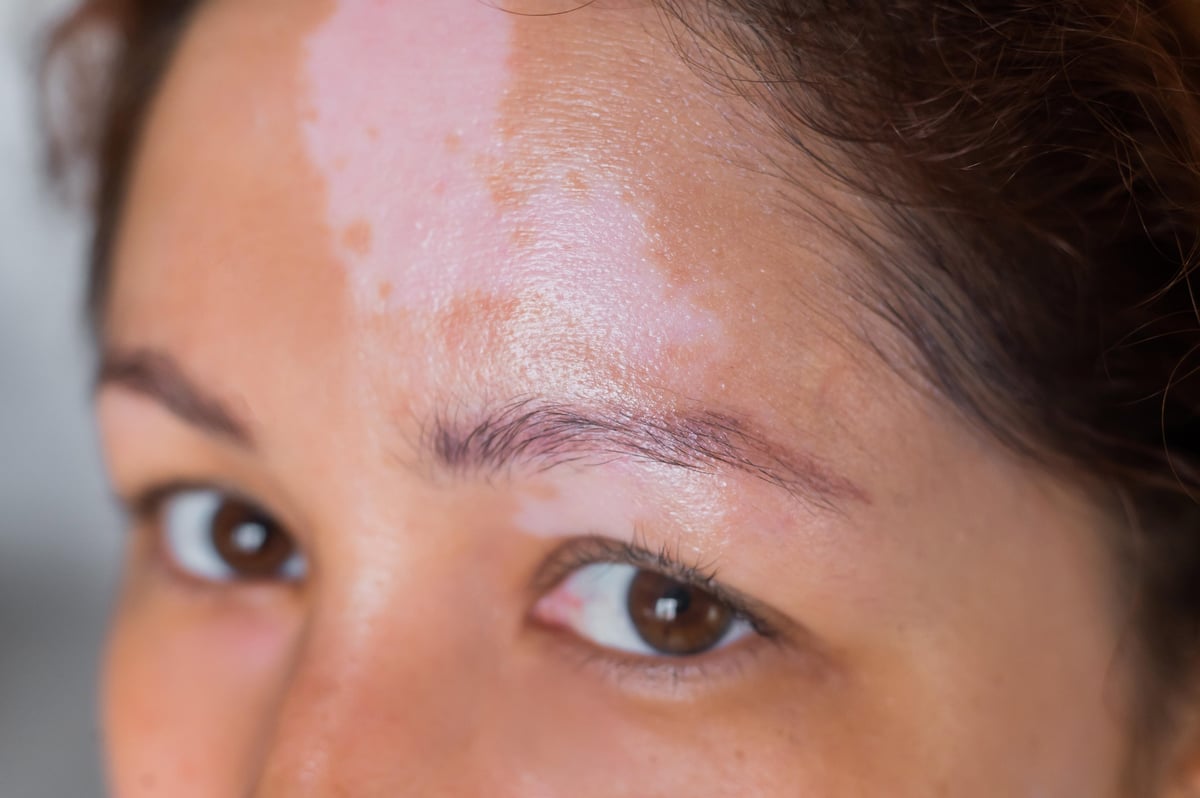
More patients receiving ruxolitinib have decrease of at least 75 percent from baseline in facial Vitiligo Area Scoring Index
THURSDAY, Oct. 20, 2022 (HealthDay News) — For patients with vitiligo, ruxolitinib cream results in greater repigmentation of lesions compared with vehicle control, according to a study published online Oct. 20 in the New England Journal of Medicine.
David Rosmarin, M.D., from Tufts Medical Center in Boston, and colleagues conducted two phase 3 trials involving patients aged 12 years or older with nonsegmental vitiligo with depigmentation covering 10 percent or less of total body surface area. Patients were randomly assigned to apply 1.5 percent ruxolitinib cream or vehicle control twice daily for 24 weeks in a 2:1 ratio, after which all patients could apply ruxolitinib cream through week 52. A total of 674 patients were enrolled: 330 in the Topical Ruxolitinib Evaluation in Vitiligo Study 1 (TruE-V1) and 344 in TRuE-V2.
The researchers found that the percentage of patients with a decrease of at least 75 percent from baseline in the facial Vitiligo Area Scoring Index response at week 24 was 29.8 percent in the ruxolitinib group and 7.4 percent in the vehicle group (relative risk [RR], 4.0) in TRuE-V1. The corresponding percentages were 30.9 percent and 11.4 percent, respectively, in TRuE-V2 (RR, 2.7). The superiority of ruxolitinib over vehicle control was demonstrated in key secondary end points. Adverse events occurred in 54.8 percent of patients in TRuE-V1 and 62.3 percent of patients in TRuE-V2 who applied ruxolitinib cream through 52 weeks.
“Ruxolitinib cream showed superiority to vehicle control in repigmentation of vitiligo. Patient-reported outcomes suggest that changes were meaningful to patients, although there were no substantial between-group differences in quality of life,” the authors write.
Several authors disclosed ties to various companies, including Incyte, who funded the study.
Abstract/Full Text (subscription or payment may be required)
.jpg) Most Specialty Oral Anticancer Meds for Blood Cancers Are Initially Rejected by Insurers
Most Specialty Oral Anticancer Meds for Blood Cancers Are Initially Rejected by Insurers  Drug Interactions Reducing Contraceptive Effectiveness Common in Epilepsy
  1 in 3 With Lupus Take Supplements, Medications With Potential for Interactions
  Holding DMARDs at Time of COVID-19 Vaccine Not Warranted in Those With Inflammatory Arthritis
  Age-, Joint-Specific Ultrasound Reference Values Set for Healthy Joints
  2013 to 2024 Saw Decrease in Benzodiazepine Prescribing
  GLP-1 Receptor Agonists, SGLT-2is Slow Renal Function Decline in T2D With Albuminuria
  Polypharmacy of Prescription Medications Increased for U.S. Older Adults




