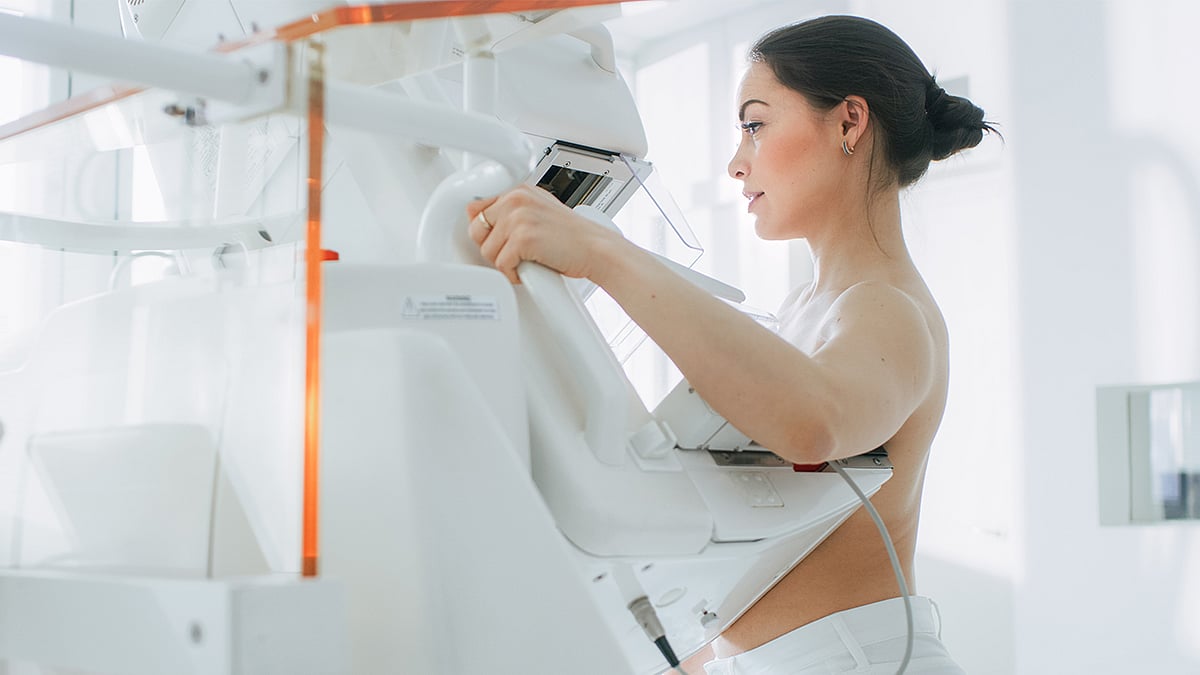
Breast fixation coverage lower with AI support, while higher fixation time seen in lesion region
MONDAY, July 14, 2025 (HealthDay News) — Artificial intelligence (AI) support improves radiologists” breast cancer detection accuracy when reading mammograms, according to a study published online July 8 in Radiology.
Jessie J.J. Gommers, Ph.D., from the Radboud University Medical Center in Nijmegen, Netherlands, and colleagues compared radiologist performance and visual search patterns when reading screening mammograms with and without an AI decision support system in a retrospective mutireader multicase study involving 12 breast screening radiologists with four to 32 years of experience from 10 institutions. Screening mammograms acquired between September 2016 and May 2019 were assessed unaided and with a U.S. Food and Drug Administration-approved, European Commission-marked AI decision support system, which assigns a region suspicion score from 1 to 100.
The study included mammography examinations from 150 women (75 with breast cancer and 75 without breast cancer). The researchers found that the mean area under the receiver operating characteristic curve was higher with AI support (unaided, 0.93; AI-supported, 0.97). No evidence was seen for a difference in mean sensitivity, specificity, or reading time. Lower breast fixation coverage was seen with AI support (11.1 versus 9.5 percent of the breast area), while higher fixation time in the lesion region was observed (4.4 versus 5.4 seconds). No evidence was seen for a difference in time to first fixation within the lesion region.
“AI not only helped radiologists focus on the right cases but also directed their attention to the most relevant regions within those cases, suggesting a meaningful role for AI in improving both performance and efficiency in breast cancer screening,” Gommers said in a statement
Several authors disclosed ties to the medical device industry.
 Gap Found Between Awareness of Breast Cancer Risk and Risk-Reducing Behavior
  Exercise Intervention Linked to Improved Attention, Memory in Breast Cancer
  Dense Breast Notification Linked to Increase in Use of Supplemental Ultrasound
  Mammography Trials Yield Excess-Incidence Patterns Consistent With Low Overdiagnosis
  Lower Breast, Cervical Cancer Screening Seen for Adults With Disabilities
  Alcohol-Attributable Cancer Mortality Has Increased Significantly in the U.S.
  Chemo-Free Combo of Four Targeted Therapies Shows Promise in Metastatic Breast Cancer
  AMH Predicts Benefit of Chemo + Endocrine Therapy in Under 55s With Breast Cancer