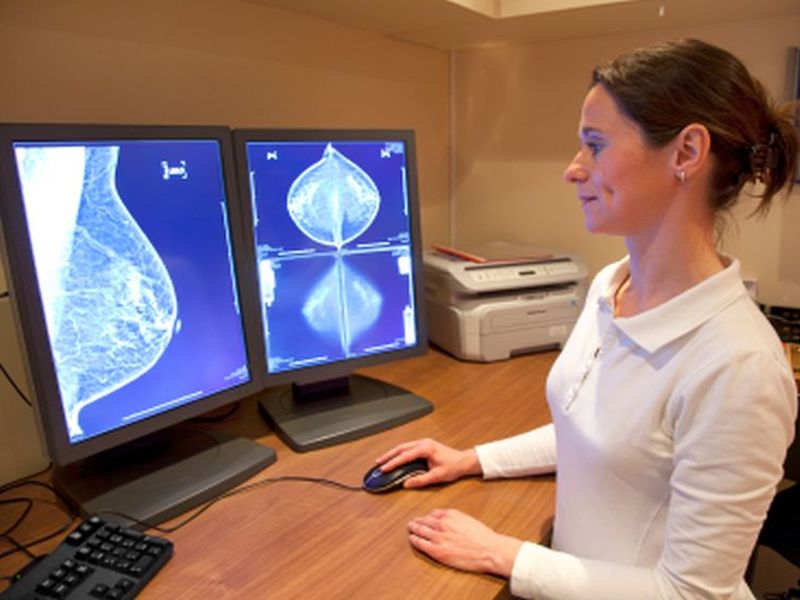
 Almost 43 percent of those presenting to NCI center for second opinion have change in diagnosis
TUESDAY, Oct. 2, 2018 (HealthDay News) — Almost 43 percent of patients diagnosed with breast cancer presenting to a National Cancer Institute (NCI)-designated cancer center for a second opinion have a change in diagnosis, according to a study published in the October issue of the Annals of Surgical Oncology.
Denise Garcia, M.D., from the Medical University of South Carolina in Charleston, and colleagues conducted a retrospective study involving patients with a breast cancer diagnosis who presented for a second opinion to the NCI-designated cancer center at the Medical University of South Carolina. Reports generated after a multidisciplinary tumor board (MTB) review and subsequent workup were compared to radiology, pathology, and genetic testing results from outside institutions. Data were included for 70 patients seeking second opinions; 47.1 percent had additional radiological images.
The researchers found that 30 additional biopsies were performed in 25 patients; in 16 patients, new cancers were identified. Additional cancers were diagnosed in 22.8 percent of the 70 patients. A second opinion led to a change in pathology interpretation for 20 percent of the 70 patients. Eleven patients underwent genetic testing; none had a mutation other than a variant of unknown significance. As a result of the MTB review, 42.8 percent of the 70 patients had a change in diagnosis after a complete workup.
“The study findings support the conclusion that referral for a second opinion is beneficial and has a diagnostic impact for many patients,” the authors write.
 Implant, Patient Survival Do Not Differ for Robotic and Conventional Total Joint Replacement
  Gap Found Between Awareness of Breast Cancer Risk and Risk-Reducing Behavior
  Exercise Intervention Linked to Improved Attention, Memory in Breast Cancer
  Physical Therapist-Supervised Exercise Improves Outcomes After ACL Reconstruction
  Ultrasound-Guided Hydrodissection Yields Improvements in Carpal Tunnel
  2013 to 2024 Saw Decrease in Benzodiazepine Prescribing
  2016 to 2024 Saw Increase in Patients Using Medical Cannabis
  Early Complications Common in Older Kidney Transplant Recipients