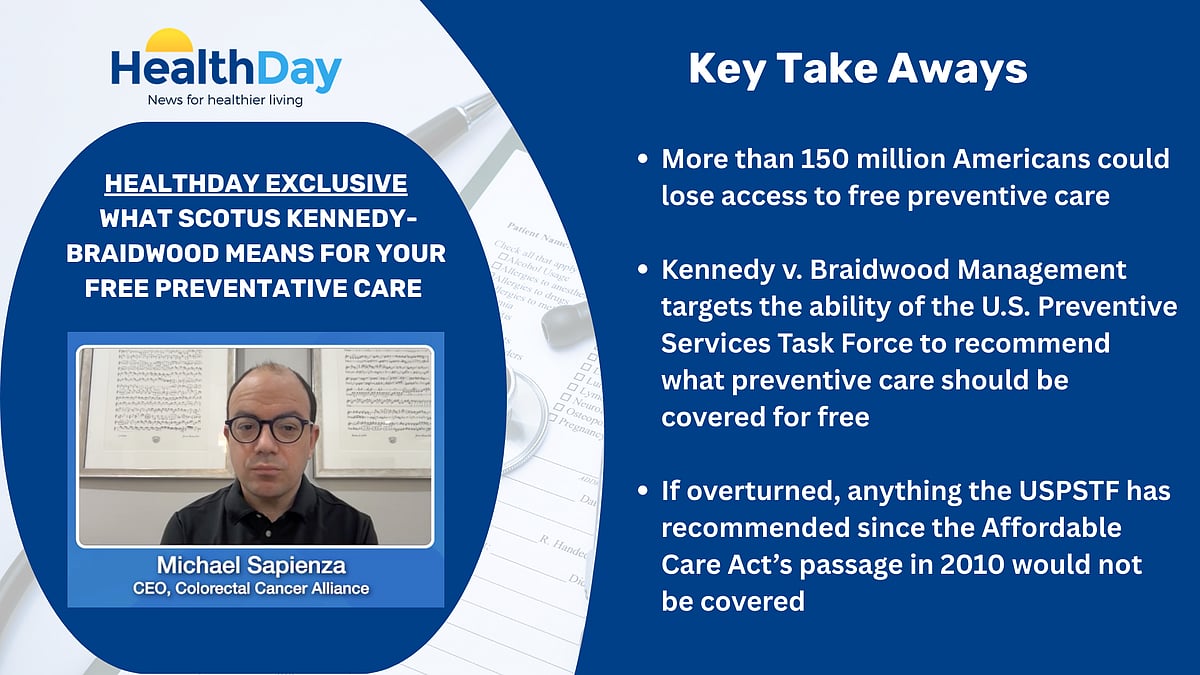
 MONDAY, April 21, 2025 (HealthDay News) — Colonoscopy for younger adults. Chest CT scans for lung cancer. Statin medications to lower cholesterol. Screening for drug addiction. More than 150 million […]
MONDAY, April 21, 2025 (HealthDay News) — Colonoscopy for younger adults. Chest CT scans for lung cancer. Statin medications to lower cholesterol. Screening for drug addiction.
More than 150 million Americans might lose no-cost access to these and other preventive care services under a case being heard Monday at the U.S. Supreme Court.
“Most people probably haven”t even heard of the case, but for many people, they feel it”s going to be the most impactful case in this Supreme Court session,” Michael Sapienza, chief executive officer of the Colorectal Cancer Alliance, said in an interview with HealthDay TV.
The case — Kennedy v. Braidwood Management — questions the way the government under the Affordable Care Act (ACA) decides which preventive care services should be covered at no cost to patients.
The ACA designated the U.S. Preventive Services Task Force (USPSTF), an independent panel of national experts, as the body that would review available medical evidence and judge which preventive measures best benefit people.
Members of the USPSTF are selected by the secretary of health and human services, a post now held by Robert F. Kennedy Jr.
The lawsuit was originally filed in 2022 by Braidwood Management on behalf of a group of conservative Christian employers in Texas who were opposed to covering medication to protect against HIV. More broadly, they argued that requiring private insurers to cover USPSTF recommendations was unconstitutional.
Under the Appointments Clause of the U.S. Constitution, they argued, USPSTF members actually should be appointed by the president and confirmed by the Senate.
If the Supreme Court agrees, insurance companies would not be required to fully cover preventive care measures that the USPSTF has recommended since the ACA’s passage in 2010, Sapienza said. One of those recommendations supports prescription medication to prevent HIV transmission.
“Basically, it would revert back to pre-ACA recommendations,” he said. “Since 2010, a lot of things have changed, whether we”re talking about cancer screenings or heart disease screenings or hypertension screenings.”
For example, the USPSTF in 2021 lowered the screening age for colon cancer from 50 to 45, making earlier screening available to millions of Americans, Sapienza said.
“Colorectal cancer is the No. 1 cause of cancer-related deaths in men under 50, so there”s a big reason why they lowered that screening age to 45,” Sapienza said.
“If the Supreme Court rules that this is unconstitutional,” he continued, “we would revert back pre-2010 recommendations, which did not recommend that people 45 to 49 would have their screenings covered.”
Overturning the ACA’s coverage of early colon cancer screening could lead to a 5% annual increase in colon cancer cases and a nearly 9% increase in colon cancer deaths by 2055, according to an analysis by the journal Health Affairs.
 Thymic Radiation Linked to Worse Outcomes in Patients With NSCLC
 .jpeg) Breathing Interventions May Curb Cravings With Substance Use
Breathing Interventions May Curb Cravings With Substance Use  87.5 Million U.S. Adults Now Eligible for Statins Under New Guidelines
  Many Adolescents Not Aware of Dangers of Fentanyl Use
  Digital Behavioral Health Game Reduces Depressive Symptoms in Teens
 .jpeg) Flu Treatment With Oseltamivir Linked to Reduced Risk for Pediatric ICU Admissions, Length of Stay
Flu Treatment With Oseltamivir Linked to Reduced Risk for Pediatric ICU Admissions, Length of Stay  4CMenB Vaccine Confers Modest Protection Against Gonorrhea in Teens
  Reinitiating Obesity Meds After Bariatric Surgery Tied to Greater One-Year Weight Loss in Youths