


 THURSDAY, June 11, 2026 (HealthDay News) — Ben Dowse hadn’t expected to treat measles when he became a doctor, but there he was, examining a newborn exposed to the virus […]
THURSDAY, June 11, 2026 (HealthDay News) — Ben Dowse hadn’t expected to treat measles when he became a doctor, but there he was, examining a newborn exposed to the virus in the womb. The infected mother had given birth just hours earlier. The hospital had alerted Dowse to the case before delivery, and he’d braced himself for the worst.
Dowse wore a full-body protective suit with a plastic face mask. As a pediatrician in southern Utah, he couldn’t risk getting even a mild infection, because many of his patients are babies too young for measles vaccines or children whose parents choose not to protect them with immunizations.
“I went in looking like a scientist in E.T.,” he said.
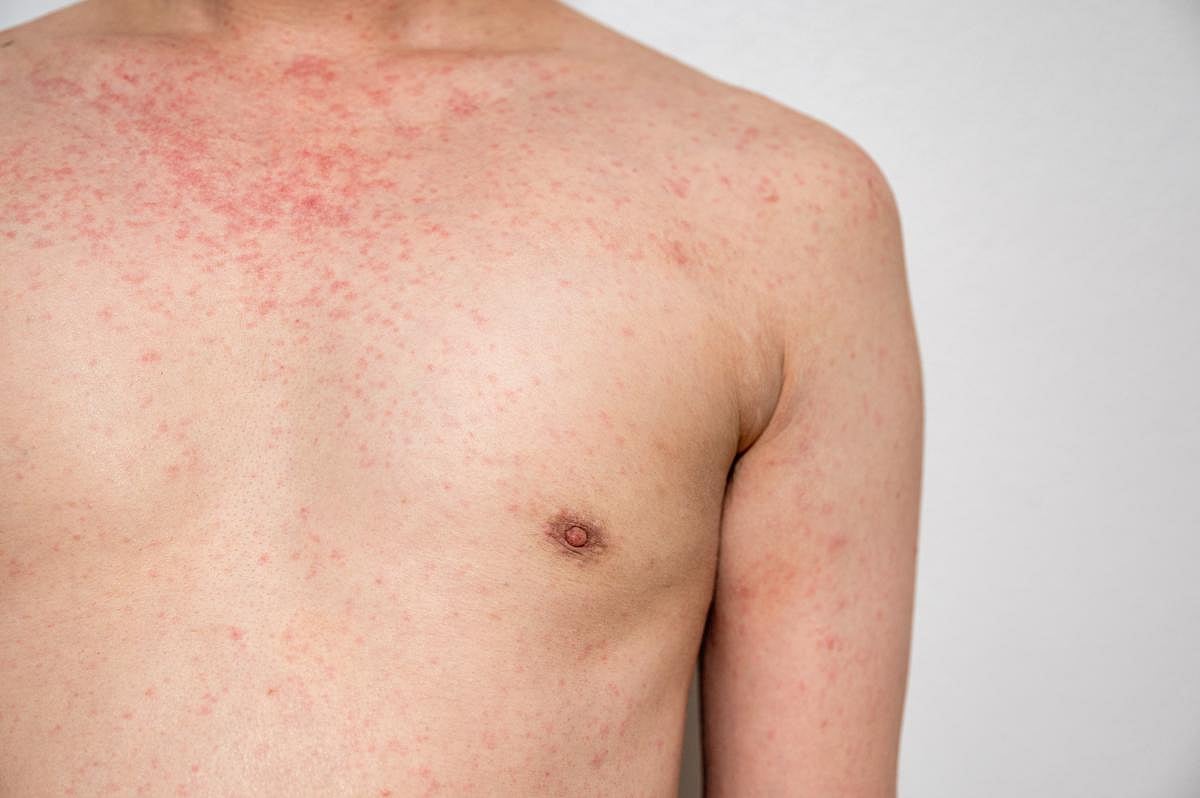
Measles can cause brain damage, deafness or death in newborns. If the baby entered the world with a measles rash and fever, Dowse was prepared to give the infant a spinal tap to assess the risk of neurological damage.
Luckily, flushed and crying, the baby looked healthy. To keep it that way, Dowse wanted to inject the baby with concentrated antibodies against the measles virus. To his surprise, the parents objected, promising to give their child “all kinds of vitamin A,” Dowse said. He begged them not to, saying, “You can’t see it on the surface, but the baby’s body is fighting the measles.” They were afraid of vaccines, so Dowse explained that antibodies were different and that they would stop measles from replicating in the infant.
“That shot is going to basically give the baby ammo to fight,” Dowse said.
The parents relented. A couple of days later, they left the hospital with a child who had narrowly skirted an infection that killed many thousands of babies a century ago. Nonetheless, Dowse said he doubted they would be returning for childhood vaccinations to protect their baby against a bevy of illnesses. Like more than a dozen Utah doctors and health officials who spoke with KFF Health News, Dowse has adjusted his expectations.
He is part of a reluctant cohort of medical professionals now on the front line of America’s regressive next chapter in health history, one in which dangerous and preventable diseases return.
“I wish that people could see what I see,” said Dr. Nathan Money, a hospital pediatrician in Utah whose eyes welled up with tears as he described children he’s treated for measles struggling to breathe.
“This train is going in the wrong direction, and it can feel like a helpless situation, because we’re just not seeing the public messaging and leadership that’s needed to turn this around,” he said.
Since measles was deemed eliminated in the U.S. a quarter-century ago, public health workers have extinguished sporadic outbreaks in close-knit, undervaccinated communities with targeted methods: Isolate people with measles and quarantine their contacts to contain the virus.
But as vaccination rates drop nationwide, the virus is moving beyond insulated communities, overwhelming public health departments constrained by shoestring budgets. Larger outbreaks, the kind not seen for a generation, have forced health officials into a new paradigm: They have stopped racing to “contain” infections and shifted gears into what they call “mitigation.”
Utah made that transition early this year, once the outbreak hit “a point where you no longer have control over it,” said state epidemiologist Dr. Leisha Nolen. By March, measles had been detected in every health jurisdiction in the state and in northern Arizona. More than 950 people have tested positive in the two states since the outbreak began in August, but many people with measles haven’t been tested.
A genetic analysis of measles viruses suggested that the true number of cases last year could have been 6.5 times what was known.
Last year under President Donald Trump, U.S. measles cases exceeded 2,000 for the first time since 1992. Six months into 2026, the U.S. has already surpassed that threshold.
Prolonged outbreaks exact a toll on children, who have spent days in hospitals for severe infections and missed weeks of school for mild ones. Adults with measles miss work. Parents delay daycare to keep their babies safe. Doctors in Utah have enacted labor-intensive protocols to keep measles from spreading in clinics. Newborns and people with weakened immune systems who have been exposed to the virus receive infusions of concentrated antibodies costing $500 to $1,000. Medical visits for measles can cost more than $33,000 per patient. Health departments spend millions trying to curb infections.
“This is like a snowball that gathers speed as it rolls downhill,” said Dr. Emilie Morris, a hospital pediatrician in Salt Lake County and Utah County.
A full-throttle campaign to educate communities on the safety of vaccines and the diseases they prevent could turn the situation around, doctors and health officials said. It would require an effort similar to what the anti-vaccine movement has long done in videos, blogs and podcasts.
For example, the anti-vaccine organization that Robert F. Kennedy Jr. founded before taking the helm at the Department of Health and Human Services, Children’s Health Defense, visits vaccine-hesitant communities, produces movies and has bought advertisements on Facebook that downplay the threat of viruses while wildly exaggerating the risk of vaccine side effects.
Kennedy’s words and actions as health secretary are adding to parents’ doubt.
After the development of vaccines and antibiotics in the mid-1900s, virologist and Nobel laureate Frank Macfarlane Burnet wrote, “One can think of the middle of the twentieth century as the end of one of the most important social revolutions in history, the virtual elimination of the infectious diseases as a significant factor in social life.”
He couldn’t have imagined what was coming.
‘Year of Sickness’
In communities nestled among the red sandstone cliffs and riparian forests of southern Utah, measles took hold last summer.
At the main school in Hildale, a town along the Arizona border, just 30% of kindergartners are considered adequately immunized by Utah’s health department, meaning they’ve gotten recommended vaccines against measles, tetanus, polio and more. Exemptions from childhood vaccine requirements are easily acquired in the state: Parents need only claim personal, religious or medical reasons.
Many people in Hildale and the surrounding towns are connected to the Fundamentalist Church of Jesus Christ of Latter-Day Saints, a sect that has been leery of the government since a police raid in 1953 separated polygamous parents from their children.
Shirlee Draper, a southern Utah resident who grew up in the faith, said they became ever more isolated in the early 2000s under the leadership of Warren Jeffs. Before he was sentenced to life in prison for sexual assault against minors, Jeffs instructed his followers to withdraw from public schools and mainstream medicine.
“Growing up, we all got our vaccines,” said Draper, who left the group during Jeffs’ reign. “It wasn’t until Warren Jeffs came along that there started to be more and more resistance.”
After Jeffs went to prison, many people left the faith but remained concerned about vaccines because of online misinformation, such as claims that the shots are toxic. Today a small shop in Hildale sells mouth sprays and oral drops professing to detoxify vaccines. Water, glycerin and “whole grain alcohol” are listed as ingredients in one called Vxx-Dtx.
A mother who KFF Health News agreed not to name, because she fears stigmatization, said she considered getting her kids vaccinated when schools in southwest Utah started seeing measles cases last summer. She had split from the fundamentalist group but still worried about vaccines giving her children autism or other complications.
Large studies published in top-tier scientific journals have refuted a link between vaccines and autism, but the anti-vaccine movement has kept the notion alive.
Then the woman’s son told her that his classmate had a rash and spit on him, she said. A few days later, he fell ill with a fever, followed by vomiting, diarrhea, and a head-to-toe rash.
“He felt downright sick for 10 to 14 days,” the woman said. “It was hard to see the end of the tunnel.”
Then her daughters came down with measles. She had a fleeting case, too, even though she had been vaccinated as a child. Breakthrough infections tend to be mild and are relatively rare. Only 4% of 4,300-plus U.S. cases reported this year and last have been people who’ve had two doses of the measles, mumps and rubella vaccine.
By the time the family recovered, the son had missed nearly three weeks of school, the daughters a month and the mother had postponed an important family gathering because she didn’t want to spread infections. “I just got my youngest’s missed-school report and it’s super high,” she said. “This is the year of sickness.”
The woman said she regretted not getting her kids vaccinated when the outbreak started. She said she knows about 30 people who have fallen sick with the measles. Except for a few who needed medical care, they haven’t been tested. “I bet there’s been thousands of cases,” she said.
Measles doesn’t have a cure. She and others have tried to ease symptoms with cod liver oil, vitamin C, zinc and “essential oils,” plant extracts long used in folk medicine that have become a lucrative industry in Utah. People in southwest Utah are trying a lot of things: One resident sells homemade lotion on Facebook, writing, “Breastmilk & Honey has been a life saver for the measles rash.”
Beyond Containment
The outbreak may have started among a fundamentalist community, but it’s spread far beyond because Utah’s vaccination rates have dropped steadily since the COVID pandemic.
Fewer than 80% of kindergartners were adequately immunized in the 2024-25 school year in southwest Utah, with only 87% adequately immunized in the state as a whole — far below the 95% threshold required for herd immunity.
Several Utahns told KFF Health News that “alternative health” or “wellness” drives the trend, rather than religion. The state has a thriving supplement industry, worth $6.1 billion in 2023, aided by deregulatory policies supported by the late Utah senator Orrin Hatch and a high concentration of people who earn income from multilevel marketing. These networks of people sell supplements, essential oils, peptides and other alternative therapies on social media, YouTube and podcasts, according to scholarly articles and industry analyses.
Alternative health isn’t necessarily anti-vaccine, but many people who sell unconventional remedies online and in podcasts deride vaccines and mainstream medicine.
“People are suspicious, and it’s well founded,” Draper said. She described dismissive doctors, exorbitant medical bills, hospital systems that put profits over care and pharmaceutical companies that drove opioid addiction. Communities already wary of government authorities are poised to interpret failings in American healthcare as signs that medical authorities aren’t to be trusted, either, she said.
“Across America, we have entire populations who find safety in clinging to whatever confirms their deeply held beliefs,” she said.
A mistrustful disposition gave way to COVID conspiracy theories in 2020 and 2021. In southwest Utah, for example, a pickup truck tricked out with digital billboards showed up to COVID vaccination sites to advertise Plandemic, a 26-minute viral video rife with conspiratorial claims, including that masks “activate” the coronavirus and that global elites planned COVID-19 to control the population. Misinformation added fuel to anger about public health rules, and there was political backlash under the umbrella of a largely Republican “medical freedom” movement. Utah enacted laws reining in public health, including one that eases exemptions to childhood vaccinations and another that prohibits most employers from requiring vaccines.
In the wake of the COVID backlash, health officials tread lightly. Rather than enforce containment measures, “we give our advice and focus on personal responsibility,” said David Heaton, public information officer at the Southwest Utah Public Health Department.
One of the most contagious diseases in the world, measles spreads with astonishing speed among the unvaccinated. One meticulous study of a New York school outbreak in 1974 found that a second-grader with measles infected 28 other students in 14 classrooms because measles can spread through ventilation systems.
As cases doubled then quadrupled in southern Utah, the regional health department couldn’t keep up with calling the contacts of everyone infected. It shifted its efforts to announcements guiding the public at large.
For example, it asks people to call before showing up to clinics with measles symptoms. Still, patients in plenty of hospitals have been exposed. For example, when parents brought a sick, unvaccinated child to a large pediatric hospital in Utah in September, they shared the space with 11 infants too young to be vaccinated. Doctors rushed to give the babies infusions of antibodies and they remained healthy, according to a recent report.
On the radio and in posts on social media, Heaton warns that measles is spreading and that vaccines are the best defense. “If you’re not immunized and you’re anywhere in public,” Heaton said, “you’re fair game for this virus.”
The department doesn’t have the capacity to talk with people directly in the five counties it serves. For a few years, it leaned on community health workers who went to churches, town halls and other gathering places, listening to people’s concerns and telling them what the science said about COVID, vaccines and other matters of public health. But these workers were laid off early last year, after the Trump administration clawed back more than $12 billion in federal public health grants to states.
“We were starting to get a little bit of traction,” Heaton said of the community workers. “And then we lost all of our team.”
The department offers free measles vaccines to children, but uptake is slow. Nursing director Mindy Bundy said that when she started the job 20 years ago, demand was so high that she would give parents tickets while they waited, as if they were crowding around a deli counter.
“Now even in an outbreak,” she said, “we aren’t seeing a huge increase of people wanting vaccination.”
 Nearly 3 in 4 Older Adults Express Interest in Vaccine to Prevent Dementia
  People With Autism Have Shorter Life Expectancy
  Updated COVID-19 Shot Beneficial for Those With Autoimmune Rheumatic Disease
  Trends Reported in Vaccination Coverage for Adolescents for 2025
 .jpg) Considerable Gaps Reported in Care for Youth With Opioid Use Disorder
Considerable Gaps Reported in Care for Youth With Opioid Use Disorder  Nutritional Deficiencies Seen in Youth Taking GLP-1 Receptor Agonists
  Youth Suicide Risk Linked to Community Firearm Violence
  AAP Issues Recommendations for Pediatric RSV Vaccination in 2026-2027 Season


.jpg)

