Accuracies were up to 84 percent for women and 77 percent for men using HTN threshold of SBP ≥135 mmHg and DBP ≥85 mmHg
FRIDAY, Sept. 13, 2024 (HealthDay News) — Predictive models for hypertension screening have been developed using speech recordings, with accuracies up to 84 percent for women and 77 percent for men, according to a study published online Sept. 10 in IEEE Access.
Behrad Taghibeyglou, from the University of Toronto, and colleagues proposed a novel framework for detecting hypertension through acoustic analysis of speech. Speech was recorded across multiple sessions, and its temporal and spectral characteristics were analyzed with an aim of identifying indicators of hypertension. Two thresholds were explored for labeling individuals with hypertension: systolic blood pressure (SBP) ≥135 mmHg or diastolic blood pressure (DBP) ≥85 mmHg and SBP ≥140 mmHg or DBP ≥90 mmHg. The study included 245 participants (91 female).
The researchers developed predictive models for each gender; their performance was assessed using leave-one-subject-out validation. For the first threshold, the balanced accuracy achieved was 84 percent for women and 77 percent for men. The corresponding balanced accuracies for the second threshold were 63 percent for women and 86 percent for men.
“These insights pave the way for further development of generalizable, non-invasive, accessible, and cuffless hypertension screening methods utilizing speech analysis,” the authors wrote.
 Mortality in Injured Children Linked to Higher SBP Thresholds Than Those That Define Hypotension
  Eating More Whole Grains Daily Linked to Cardiometabolic Benefits
  Midlife Onset of Increasing Pulse Pressure Not Linked to Menopause
 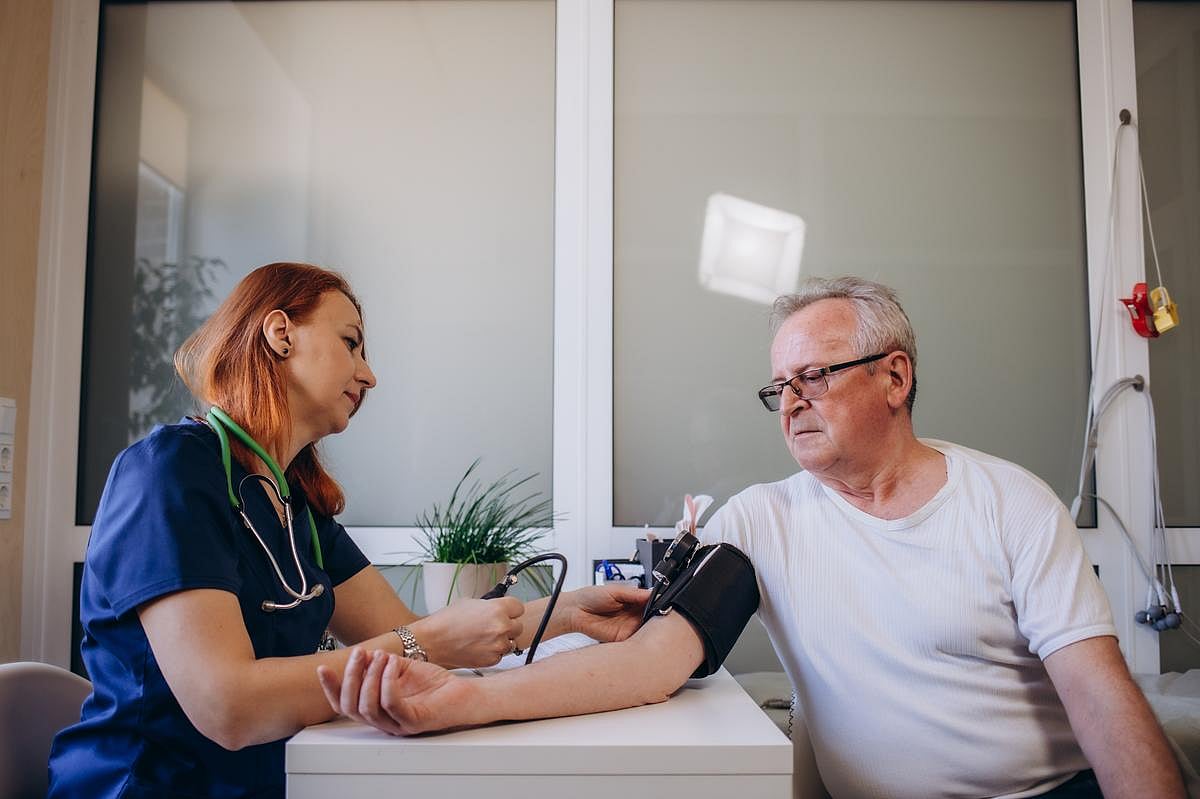 Intensive BP Lowering Reduces Recurrent Stroke After Intracerebral Hemorrhage
  Risk for Ischemic Stroke Increased After Cancer Diagnosis
  Use of SAMA, SABA Linked to Cardiovascular Events, Mortality in Asthma, COPD
  NOACs Linked to Slower Cognitive Decline in Patients With A-Fib, Alzheimer Disease
  Recommendations Updated for Adult Stroke Rehabilitation, Recovery