


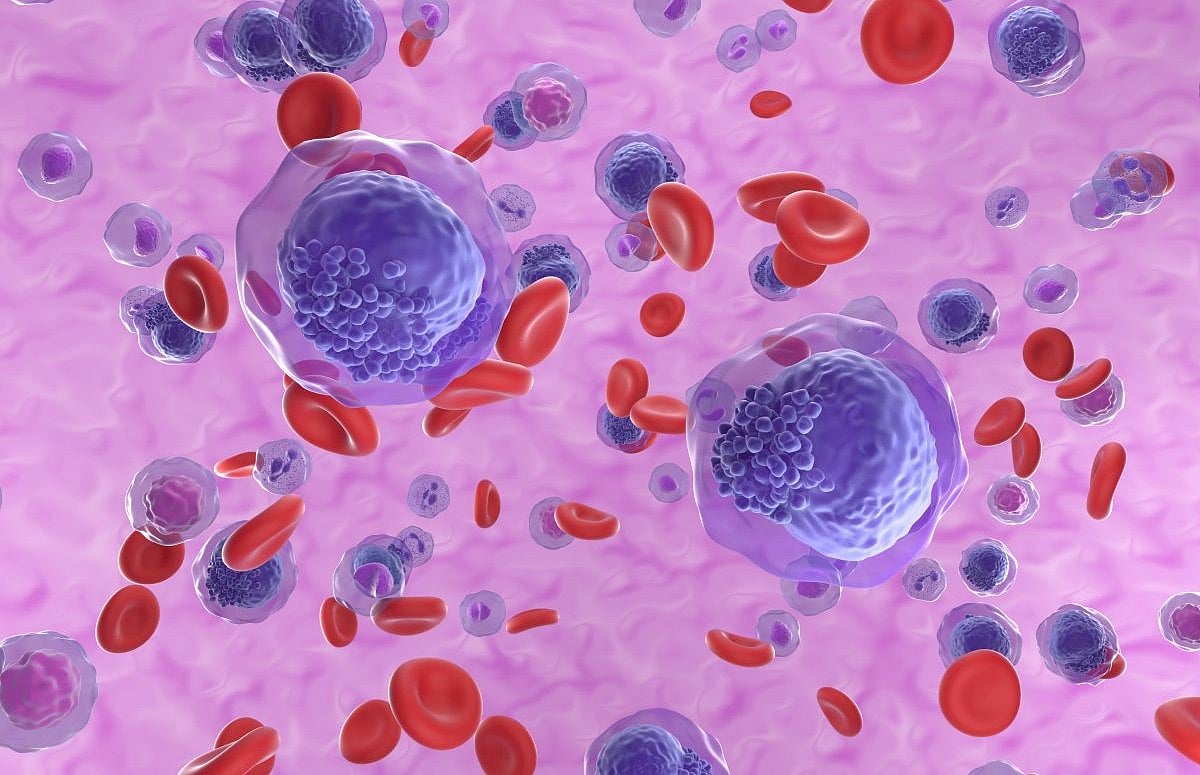
47 percent of patients had complete response; median overall survival 15.5 months with decitabine-cedazuridine plus venetoclax
MONDAY, June 8, 2026 (HealthDay News) — An oral drug combination is effective for older patients with acute myeloid leukemia (AML) who are ineligible for intensive chemotherapy, according to a study published in the June 4 issue of the New England Journal of Medicine.
Gail J. Roboz, M.D., from Weill Cornell Medicine and New York-Presbyterian Hospital in New York City, and colleagues conducted a phase 1 to 2 open-label, multicenter nonrandomized trial involving patients with newly diagnosed AML aged 75 years or older who were ineligible for intensive chemotherapy. Participants received oral decitabine-cedazuridine plus oral venetoclax. Scheduled adjustments were encouraged in phase 2b after bone marrow blast clearance to mitigate myelosuppression observed in phase 1.
Overall, 189 patients were enrolled in the study: 30 in phase 1, 58 in phase 2a, and 101 in phase 2b. The researchers observed no drug-drug interactions between decitabine-cedazuridine and venetoclax. The percentage of patients with a complete response in phase 2b was 47 percent, while 63 percent had a complete response or complete response with incomplete hematologic recovery; median overall survival was 15.5 months. In phase 2b, common adverse events of grade 3 or higher were anemia, neutropenia, and febrile neutropenia (in 30, 26, and 25 percent of patients, respectively). Mortality was 3 and 10 percent at 30 and 60 days, respectively.
“Having received approval, we anticipate that this oral AML regimen will become the standard of care for patients who are older or more frail,” Roboz said in a statement. “We hope these results point to a future for AML patients where the treatment journey is less disruptive and less burdensome without sacrificing outcomes.”
Several authors disclosed ties to biopharmaceutical companies, including Taiho Oncology, which funded the study.
Abstract/Full Text (subscription or payment may be required)
 Response to Autologous HSCT Durable for Patients With Systemic Sclerosis
 Early Survivorship Care Linked to Improved Outcomes in Head, Neck Cancer
.jpg) Recurrent Visual Field Progression Happens for 1 in 4 With Glaucoma
 Exercise Intervention Linked to Improved Attention, Memory in Breast Cancer
.jpg) Cancer Survivors Have Lower Levels of Physical Activity
 Childhood Cancer Survivors Often Have Mental Distress in Adulthood
 Mindfulness, Tai Chi May Benefit Cancer Survivors
 Blinatumomab Improves Event-Free Survival in Children With High-Risk B-Cell ALL





